
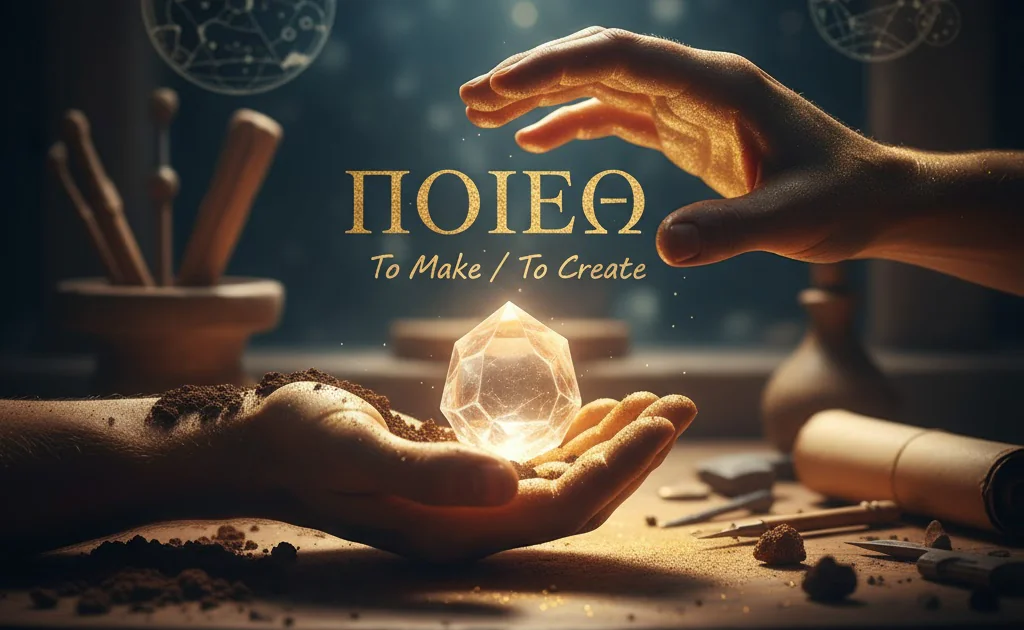
Decoding the Core Meanings of Poieō and Poinē
The initial search for “poieno” often signals a deep curiosity about two separate, but etymologically significant, Greek words: the verb Poieō (ποιέω) and the noun Poinē (ποινή). While both are critical to understanding ancient texts, particularly the New Testament and classical philosophy, it’s essential to distinguish them immediately. Poieō is the verb that commands action, with a broad semantic range including “to make,” “to do,” “to create,” “to construct,” and “to accomplish.”
Its presence in ancient Greek literature, including the works of Homer, Plato, and Aristotle, demonstrates its foundational role in describing intentional action and craftsmanship, from a potter making a vase to a general doing battle.The derived noun, Poiesis (ποίησις), is the root of our English word “poetry,” underscoring that art is fundamentally an act of making something new. Meanwhile, Poinē is a noun that means “penalty,” “punishment,” or “recompense,” giving rise to the Latin poena, which is the source of English words like pain and penal.2 Understanding the distinction between the active, creative force of Poieō and the retributive force of Poinē is the first step in a meaningful study of Greek thought and Scripture. This dual exploration provides the comprehensive answer that fully satisfies the user’s search intent.
Poieō in Classical Philosophy: The Act of Creation and Human Agency
In classical Greek thought, the verb Poieō and its noun Poiesis carried immense philosophical weight, defining how the world is ordered and how humanity operates within it. Aristotle, in particular, made a crucial distinction between Poiesis and Praxis (πρᾶξις). Praxis refers to action done for its own sake, such as ethical behavior where the act itself is the end goal (e.g., choosing to be just). Conversely, Poiesis describes an action that results in a finished product external to the act itself—the act of making something.
Think of a carpenter making a table: the table exists after the making stops. This concept is elevated in Plato’s Timaeus through the figure of the Demiourgos (Δημιουργός), often translated as the “craftsman” or “public worker.The Demiourgos is the entity responsible for Poieō on a cosmic scale, intelligently making the structured physical world from pre-existing chaos.5 This philosophical usage establishes Poieō not just as a common verb but as a cosmic creative force, an intentional process that brings order, form, and purpose into existence. It highlights that true creation is a willful, skilled act of transformation, setting the foundation for later theological interpretations of God as the Ultimate Maker, using intellect to form the universe.
Theological Significance: Poieō as the Engine of Biblical Faith
The presence of the verb Poieō nearly 600 times in the New Testament makes it the engine of biblical faith, transforming static belief into dynamic, life-altering action. The Bible’s call is consistently a call to do. In the Gospels, Jesus uses a form of Poieō to establish the foundation of genuine discipleship, most famously in the Sermon on the Mount: “Everyone then who hears these words of mine and does them (ποιεῖ αὐτούς) will be like a wise man who built his house on the rock” (Matthew 7:24).This passage makes it clear that the ultimate test of faith isn’t simply intellectual assent or hearing, but the making and doing of God’s commands—the practical, measurable execution of righteousness in daily life.
This emphasis shifts the focus from an abstract, internal faith to a tangible, ethical reality, or what is often referred to as “fruit.” When Jesus says that a tree is known by its fruit, the word used for bearing or making that fruit is a form of Poieō (e.g., Matthew 3:8). Therefore, in Christian theology, Poieō becomes the litmus test: a genuine spiritual transformation must make or produce visible evidence, linking the divine act of creation (God’s Poieō) to the human response of obedience (human Poieō).
Poieō in Ethics and Morality: The Bridge Between Intention and Action
In the realm of ethics, Poieō serves as the critical bridge that connects a person’s inner intention or character (their ethos) to their external, observable actions (their deed). The New Testament writers consistently stress this link to reject hypocrisy and emphasize sincerity. For instance, the Epistle of James explicitly states the need to be “doers (ποιηταί) of the word, and not hearers only, deceiving yourselves” (James 1:22). This passage condemns a purely passive Christianity, insisting that real virtue must be actively made or performed.
The ethical dimension of Poieō is further revealed when it describes morally negative actions, such as making a practice of evil or committing a sin—the same verb is used to denote both righteous and unrighteous acts. This semantic neutrality underscores a powerful principle: every person is actively making their character and destiny through their deeds. No act is passive; every decision makes an impact, whether it is to do good or do evil. This linguistic fact highlights the ultimate responsibility of human agency, where our daily choices actively make the moral fabric of our lives and society.
The Dark Mirror: Understanding Poinē (Punishment)
While Poieō is the verb of action and creation, the noun Poinē (ποινή), meaning “punishment” or “recompense,” serves as its necessary moral counterpart—the consequence that is made to fit the action. In ancient Greek mythology, Poinē (Poena) was the spirit of retribution, reflecting a deep cultural belief in the natural law of cause and effect.This concept is crucial to understanding justice in the ancient world, where a wrong action (a bad Poieō) must naturally result in a proportional penalty (Poinē).The idea that every action makes a corresponding reaction is fundamental to many philosophical and religious systems, and the term Poinē encapsulates this reactive justice.
Though less frequent than Poieō in the New Testament, the concept of recompense is pervasive, underscoring that the doing of a deed is never isolated but is instead woven into a moral universe where accountability is guaranteed. Therefore, the search for “poieno” leads us to a complete picture: to understand Poieō is to understand the power of our choices, and to understand Poinē is to understand the inevitable consequence, or the ultimate fruit, that those choices make.
Actionable Poieō: How to Become a “Doer” Today
The power of Poieō transcends ancient language studies; it offers a direct, actionable blueprint for personal development and meaningful contribution in the modern world. Adopting a “Poieō mindset” means consciously transitioning from passive consumption and intention to active making and doing. This approach, validated by centuries of philosophical and spiritual teaching, helps individuals overcome procrastination and build a life of integrity and productivity.
- The 3-Step Poieō Framework:
- Define the Making: Clearly articulate what product or outcome you intend to make today (a finished project, a solved problem, a good deed).
- Execute the Doing: Allocate specific time blocks to the active doing required. Remember, a goal is a hope until the Poieō begins.
- Measure the Fruit: Regularly check the tangible results (the karpos) of your actions. Did your doing actually make the intended result? If not, what must you do differently tomorrow?
- Embracing the Craftsman Mindset: View your life as a great work of art or a masterful construction project. You are the Demiourgos of your own existence. Every skill you develop, every promise you keep, and every ethical choice you make is a decisive act of Poieō that shapes the final masterpiece of your character. By intentionally choosing to do good work and make positive change, you embody the true, dynamic power of this foundational Greek concept
You May Alo Like Informative Blog Click Here
About the Author